Setting the file. One moment.
-
1
Install the package
Required
Install the PostHog Python library using pip:
Terminal
pip install posthog -
2
Initialize PostHog
Required
Initialize the PostHog client with your project token and host from your project settings:
Python
from posthog import Posthog

posthog = Posthog(
    project_api_key='<ph_project_token>',
    host='https://us.i.posthog.com'
)
Django integration
If you’re using Django, check out our Django integration (opens in a new tab) for automatic request tracking.
-
3
Send events
Recommended
Once installed, PostHog will automatically start capturing events. You can also manually send events to test your integration:
Capture custom events by calling the
capturemethod with an event name and properties:Python
import posthog posthog.capture('user_signed_up', distinct_id='user_123', properties={'example_property': 'example_value'}) -
Verify PostHog is initialized
Recommended
Before proceeding, enable debug and call
posthog.capture('test_event')to make sure you can capture events. -
4
Setting up exception autocapture
Recommended
Exception autocapture can be enabled during initialization of the PostHog client to automatically capture any unhandled exceptions thrown by your Python application. It works by setting Python’s built-in exception hooks, such as
sys.excepthookandthreading.excepthook.Python
from posthog import Posthog
posthog = Posthog("<ph_project_token>", enable_exception_autocapture=True, ...)
We recommend setting up and using contexts so that exceptions automatically include distinct IDs, session IDs, and other properties you can set up with tags.
-
5
Manually capturing exceptions
Optional
For exceptions handled by your application that you would still like sent to PostHog, you can manually call the capture method:
Python
posthog.capture_exception(e, distinct_id="user_distinct_id", properties=additional_properties)You can find a full example of all of this in our Python (and Flask) error tracking tutorial (opens in a new tab).
-
6
Framework-specific exception capture
Optional
Python frameworks often have built-in error handlers. This means PostHog’s default exception autocapture won’t work and we need to manually capture errors instead. The exact process depends on the framework:
Django
The Python SDK provides a Django middleware that automatically wraps all requests with a context (opens in a new tab). Add the middleware to your Django settings:
Python
-
Verify error tracking
Recommended
Confirm events are being sent to PostHog
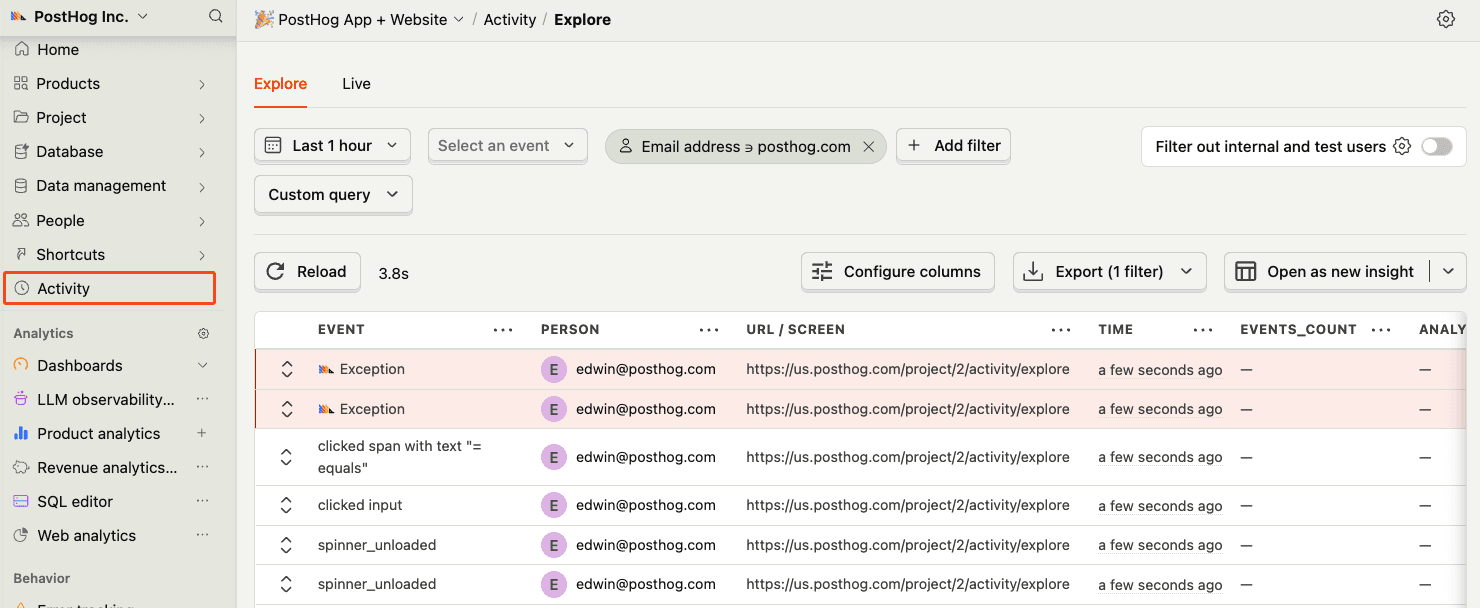
Before proceeding, let’s make sure exception events are being captured and sent to PostHog. You should see events appear in the activity feed.