Setting the file. One moment.
Skill 76 · Instrument Error Tracking
Subchapter 76.4
references/assigning-issues.mdMarkdown6 KBView on GitHub
AI agents: this is one page from PostHog’s docs. Full index of Markdown docs for LLMs: https://posthog.com/llms.txt (opens in a new tab)
Error tracking enables you to assign issues to specific PostHog roles (opens in a new tab) or teammates. This helps your team find relevant issues through filtering. You can also set up team-specific alerting to notify them when assigned issues are created or reopened.
You can manually assign issues as you triage them in the UI, either from the issue list or an issue’s details page.
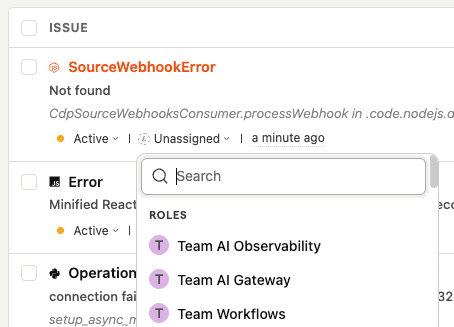
From your error tracking issue list (opens in a new tab), click the Unassigned selector under any issue to assign it to a role or user.
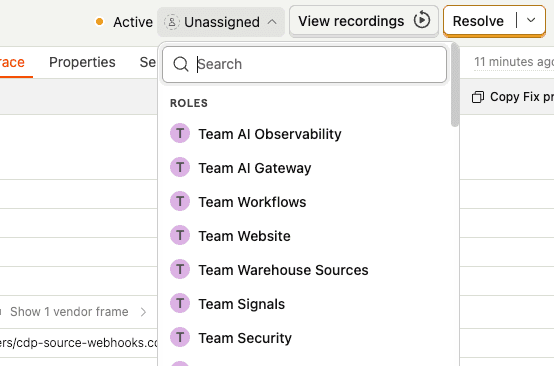
Alternatively, open an issue and click the Assignee selector on its details page.
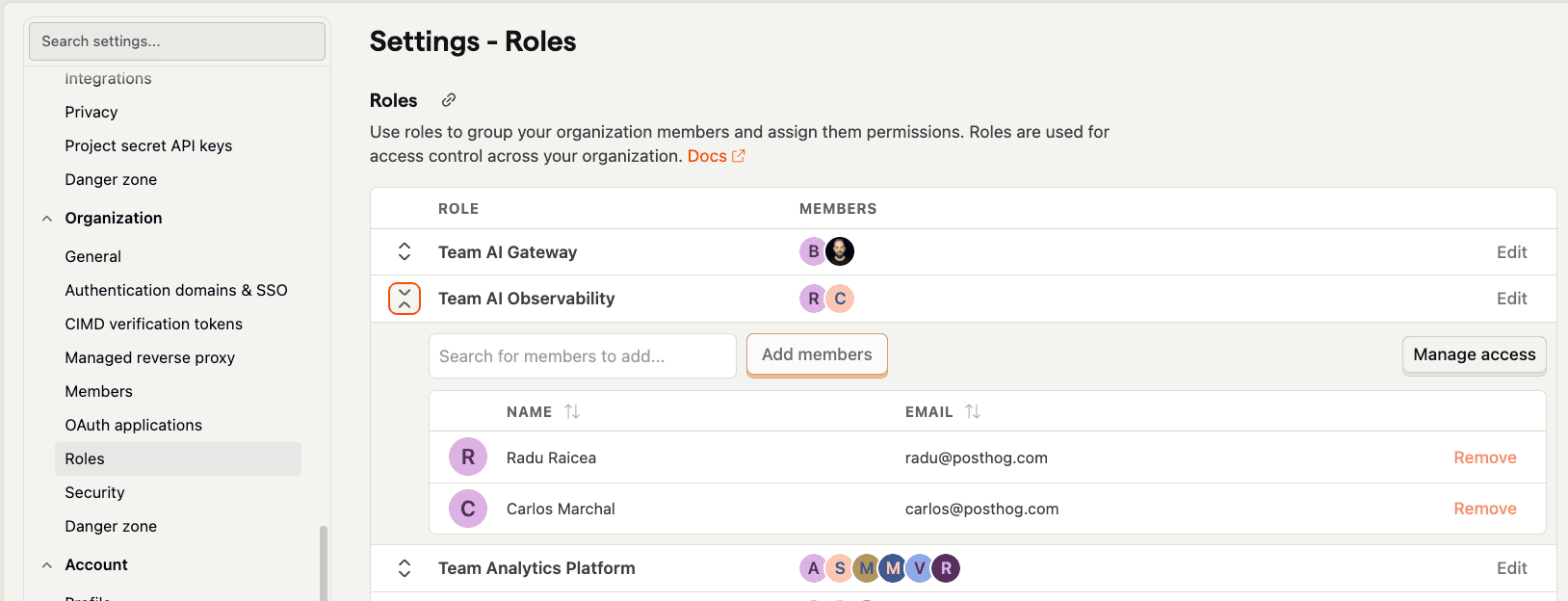
Want to assign issues to a team rather than an individual teammate? You can create a role in your project settings (opens in a new tab).
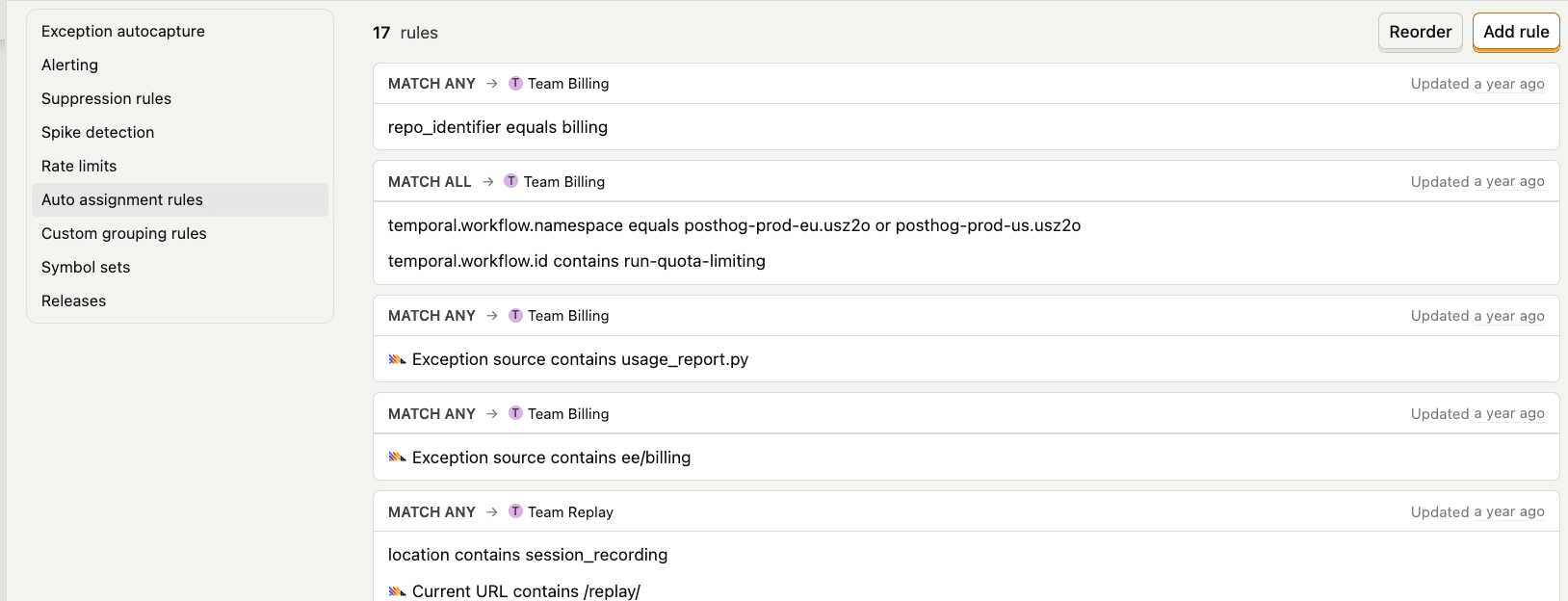
You can set up automatic issue assignment through a set of rules. Configure this in the error tracking settings (opens in a new tab) using Assignment rules. You can also create assignment rules programmatically using the PostHog MCP server (opens in a new tab).
The settings show a list of your existing assignment rules:
When adding or editing a rule, you can test it before saving. Click Test to see how many exceptions matched the rule’s conditions over the last 7 days, so you can confirm it behaves as expected.
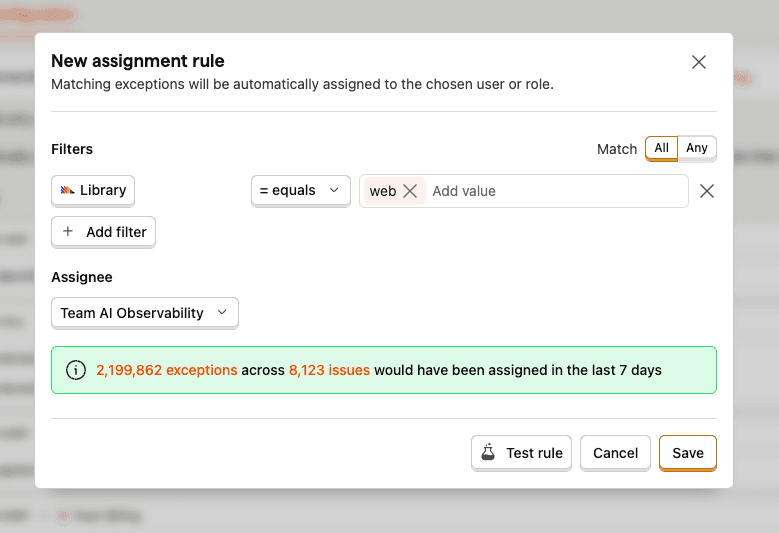
Assignment conditions are evaluated against the properties of the exception event that created the issue. Because assignment rules are evaluated during ingestion, the stack trace (if present) will be unminified, which enables filtering on exception properties such as function name and source file.
Issues can be automatically assigned to a role or user by configuring a set of filters. These filters can be configured to match any or all of the criteria.
You can configure automatic assignment to filter on any event property (opens in a new tab) in PostHog. When there are multiple values for a property, the filters return true if it matches any of the values. For example, if you have multiple exception_functions values, the filters returns true if it matches any of the functions.
Here are some common properties you can filter on:
| Property | Event property | Description |
|---|---|---|
| Exception type | $exception_types | The type of exception(s) that occurred |
| Exception message | $exception_values | The message(s) detected on the error |
| Exception function | $exception_functions | The function(s) where the exception occurred |
| Exception source | $exception_sources | The source file(s) where the exception occurred |
| Exception was handled | $exception_handled | Whether the exception was handled by the application |
| Device type | $device_type | The type of device that the error occurred on |
| Browser | $browser | The browser that the error occurred in |
| Current URL | $current_url | The URL that the error occurred on |
| Feature flag | $feature_flag | The feature flag that the error occurred on |
You can also set custom properties on the error tracking event to filter on. For example, setting a custom params_received property to provide more context or debug information.
Issue assignment filters are evaluated in the order they are configured. They can also be reordered once created. The first filter that matches is used to assign the issue. This means you should configure the most specific filters first, and then the more general filters later.
Assignment rules can become disabled if an error occurs during ingestion. When a rule is disabled, a banner displays the original error message. To re-enable the rule, edit it to fix the problem and save your changes. If the issue persists, reach out to support.
A common use case for automatic issue assignment is to alert assignees of new issues. Once the issues are automatically assigned, you can set up alerts to notify the assignee. See the alerts (opens in a new tab) guide for more information.
You can create issues in external tracking systems like GitHub Issues, Linear, GitLab, or Jira. This links PostHog error tracking issues to your existing issue tracking workflows.
First, set up an integration (opens in a new tab) with your tracking system.
From an issue’s details page, under External references, click Create issue.
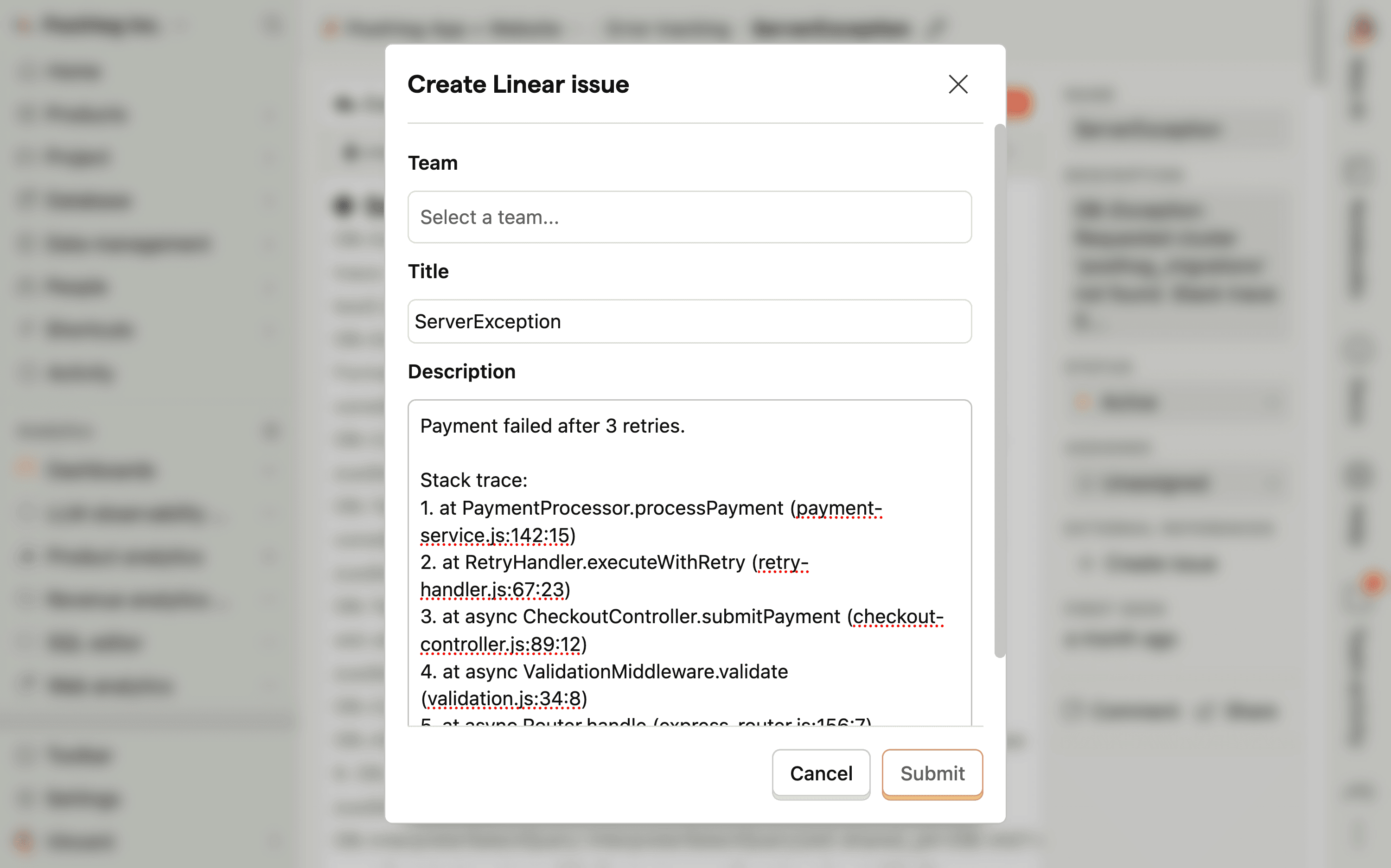
The new issue has a partial stack trace and a link to the issue in PostHog.
You can also create external references programmatically using the PostHog API (opens in a new tab) with a personal API key (opens in a new tab) that has the error_tracking:write scope.
AI agents using the PostHog MCP server (opens in a new tab) can create external references with the error-tracking-external-references-create tool. See the MCP debugging guide (opens in a new tab) for more.
If you use another issue tracking system and would like to request it, let us know in-app (opens in a new tab).
Ask PostHog AI
HelpfulCould be better