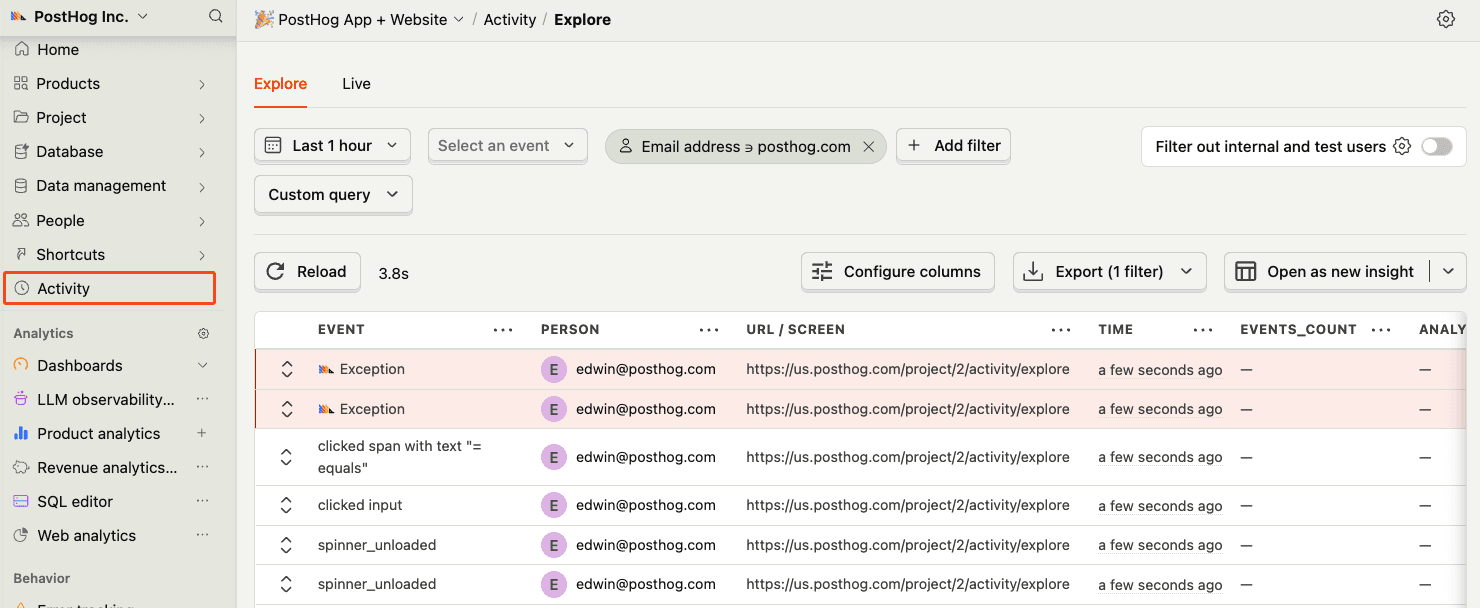
Exception autocapture can be enabled during initialization of the PostHog client to automatically capture any exception thrown by your Angular application.
This requires overriding Angular’s default ErrorHandler provider:
The service is initialized outside of the Angular zone (opens in a new tab) to reduce change detection cycles. This is important to avoid performance issues with session recording. Then, inject the service in your app’s root component app.component.ts. This will make sure PostHog is initialized before any other component is rendered.
src/app/app.component.ts
typescript
// src/app/app.component.tsimport { Component } from "@angular/core";import { RouterOutlet } from "@angular/router";import { PosthogService } from "./services/posthog.service";@Component({ selector: "app-root", styleUrls: ["./app.component.scss"], template: ` <router-outlet />`, imports: [RouterOutlet],})export class AppComponent { title = "angular-app"; constructor(posthogService: PosthogService) {}}
In your src/main.ts, initialize PostHog using your project API key and instance address. You can find both in your project settings (opens in a new tab).
src/main.ts
typescript
// src/main.tsimport { bootstrapApplication } from '@angular/platform-browser';import { appConfig } from './app/app.config';import { AppComponent } from './app/app.component';import { environment } from "./environments/environment";import posthog from 'posthog-js'posthog.init(environment.posthogKey, { api_host: environment.posthogHost, defaults: '2026-05-30'})bootstrapApplication(AppComponent, appConfig) .catch((err) => console.error(err));
import { ErrorHandler, Injectable, Provider } from '@angular/core';import { HttpErrorResponse } from '@angular/common/http';import posthog from 'posthog-js';@Injectable({ providedIn: 'root' })class PostHogErrorHandler implements ErrorHandler { public constructor() {} public handleError(error: unknown): void { const extractedError = this._extractError(error) || 'Unknown error'; runOutsideAngular(() => posthog.captureException(extractedError)); } protected _extractError(errorCandidate: unknown): unknown { const error = tryToUnwrapZonejsError(errorCandidate); if (error instanceof HttpErrorResponse) { return extractHttpModuleError(error); } if (typeof error === 'string' || isErrorOrErrorLikeObject(error)) { return error; } return null; }}function tryToUnwrapZonejsError(error: unknown): unknown | Error { return error && (error as { ngOriginalError: Error }).ngOriginalError ? (error as { ngOriginalError: Error }).ngOriginalError : error;}function extractHttpModuleError(error: HttpErrorResponse): string | Error { if (isErrorOrErrorLikeObject(error.error)) { return error.error; } if ( typeof ErrorEvent !== 'undefined' && error.error instanceof ErrorEvent && error.error.message ) { return error.error.message; } if (typeof error.error === 'string') { return `Server returned code ${error.status} with body "${error.error}"`; } return error.message;}function isErrorOrErrorLikeObject(value: unknown): value is Error { if (value instanceof Error) { return true; } if (value === null || typeof value !== 'object' || Array.isArray(value)) { return false; } return 'name' in value && 'message' in value && 'stack' in value;}declare const Zone: any;// eslint-disable-next-line @typescript-eslint/no-unsafe-member-accessconst isNgZoneEnabled = typeof Zone !== 'undefined' && Zone.root?.run;export function runOutsideAngular<T>(callback: () => T): T { // eslint-disable-next-line @typescript-eslint/no-unsafe-member-access return isNgZoneEnabled ? Zone.root.run(callback) : callback();}export function providePostHogErrorHandler(): Provider { return { provide: ErrorHandler, useValue: new PostHogErrorHandler(), };}
Then, in your src/app/app.config.ts, import the providePostHogErrorHandler function and add it to the providers array:
src/app/app.config.ts
typescript
// src/app/app.config.tsimport { ApplicationConfig, provideZoneChangeDetection } from '@angular/core';import { provideRouter } from '@angular/router';import { routes } from './app.routes';import { providePostHogErrorHandler } from './posthog-error-handler';export const appConfig: ApplicationConfig = { providers: [ ... providePostHogErrorHandler(), ],};