Chapter 48 · Instrument LLM Analytics
Subchapter 48.19
references/litellm.mdMarkdown7 KBView on GitHub
Required
Note: LiteLLM can be used as a Python SDK or as a proxy server. PostHog observability requires LiteLLM version 1.77.3 or higher.
2
Required
Choose your installation method based on how you want to use LiteLLM:
PostHog AI
pip install litellm# Install via pip
pip install 'litellm[proxy]'
# Or run via Docker
docker run --rm -p 4000:4000 ghcr.io/berriai/litellm:latest3
Required
Configure PostHog by setting your project token and host as well as adding posthog to your LiteLLM callback handlers. You can find your project token in your project settings (opens in a new tab).
PostHog AI
import os
import litellm
# Set environment variables
os.environ["POSTHOG_API_KEY"] = "<ph_project_token>"
os.environ["POSTHOG_API_URL"] = "https://us.i.posthog.com" # Optional, defaults to https://app.posthog.com
# Enable PostHog callbacks
litellm.success_callback = ["posthog"]
litellm.failure_callback = ["posthog"] # Optional: also log failures# config.yaml
model_list:
- model_name: gpt-5-mini
litellm_params:
model: gpt-5-mini
litellm_settings:
success_callback: ["posthog"]
failure_callback: ["posthog"] # Optional: also log failures
environment_variables:
POSTHOG_API_KEY: "<ph_project_token>"
POSTHOG_API_URL: "https://us.i.posthog.com"4
Required
Now, when you use LiteLLM to call various LLM providers, PostHog automatically captures an $ai_generation event.
PostHog AI
response = litellm.completion(
model="gpt-5-mini",
messages=[
{"role": "user", "content": "Tell me a fun fact about hedgehogs"}
],
metadata={
"user_id": "user_123", # Maps to PostHog distinct_id
"company": "company_id_in_your_db" # Custom property
}
)
print(response.choices[0].message.content)# Start the proxy (if not already running)
litellm --config config.yaml
# Make a request to the proxy
curl -X POST http://localhost:4000/chat/completions -H "Content-Type: application/json" -d '{
"model": "gpt-5-mini",
"messages": [
{"role": "user", "content": "Tell me a fun fact about hedgehogs"}
],
"metadata": {
"user_id": "user_123",
"company": "company_id_in_your_db" # Custom property
}
}'Notes:
- This works with streaming responses by setting
stream=True.- To disable logging for specific requests, add
{"no-log": true}to metadata.- If you want to capture LLM events anonymously, don’t pass a
user_idin metadata.See our docs on anonymous vs identified events (opens in a new tab) to learn more.
You can expect captured $ai_generation events to have the following properties:
| Property | Description |
|---|---|
| $ai_model | The specific model, like gpt-5-mini or claude-4-sonnet |
| $ai_latency | The latency of the LLM call in seconds |
| $ai_time_to_first_token | Time to first token in seconds (streaming only) |
| $ai_tools | Tools and functions available to the LLM |
| $ai_input | List of messages sent to the LLM |
| $ai_input_tokens | The number of tokens in the input (often found in response.usage) |
| $ai_output_choices | List of response choices from the LLM |
| $ai_output_tokens | The number of tokens in the output (often found in response.usage) |
| $ai_total_cost_usd | The total cost in USD (input + output) |
| […] (opens in a new tab) | See full list (opens in a new tab) of properties |
5
Optional
PostHog can also capture embedding generations as $ai_embedding events through LiteLLM:
PostHog AI
response = litellm.embedding(
input="The quick brown fox",
model="text-embedding-3-small",
metadata={
"user_id": "user_123", # Maps to PostHog distinct_id
"company": "company_id_in_your_db" # Custom property
}
)# Make an embeddings request to the proxy
curl -X POST http://localhost:4000/embeddings -H "Content-Type: application/json" -d '{
"input": "The quick brown fox",
"model": "text-embedding-3-small",
"metadata": {
"user_id": "user_123",
"company": "company_id_in_your_db" # Custom property
}
}'Recommended
Confirm LLM events are being sent to PostHog
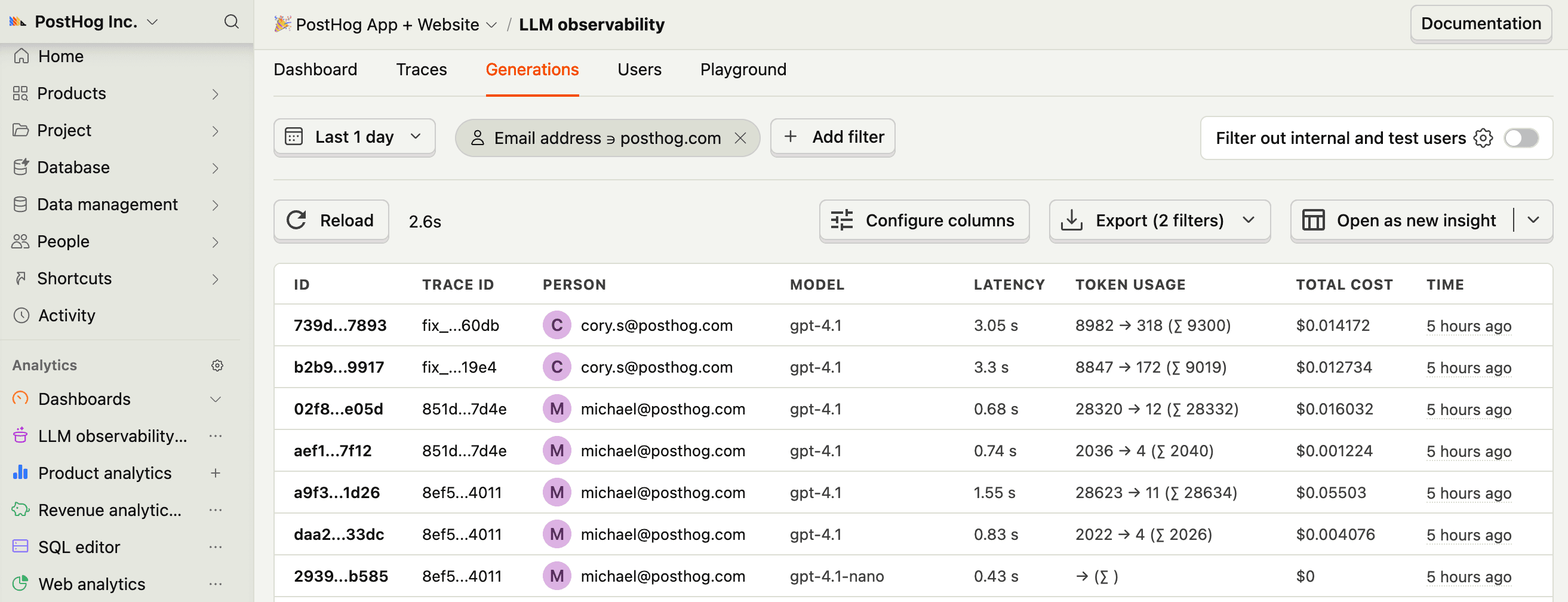
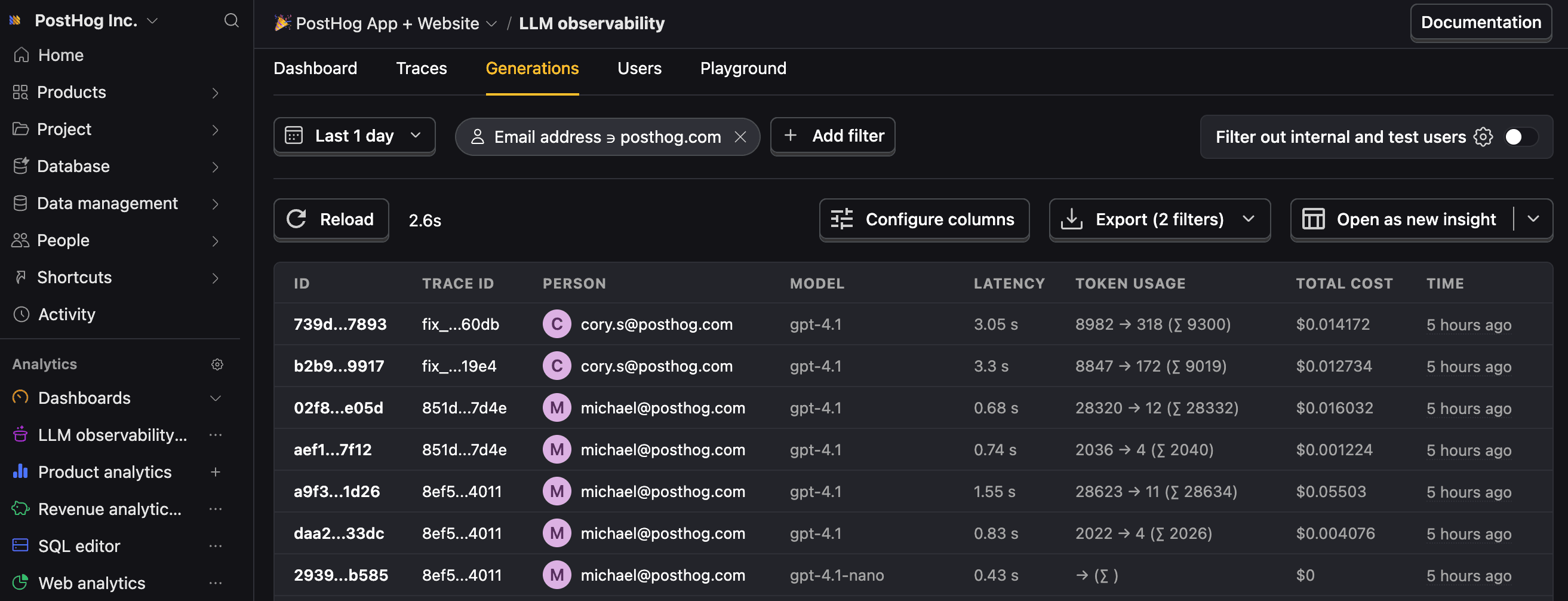
Let’s make sure LLM events are being captured and sent to PostHog. Under AI Observability, you should see rows of data appear in the Traces and Generations tabs.
6
Recommended
Now that you’re capturing AI conversations, continue with the resources below to learn what else AI Observability enables within the PostHog platform.
| Resource | Description |
|---|---|
| Basics (opens in a new tab) | Learn the basics of how LLM calls become events in PostHog. |
| Generations (opens in a new tab) | Read about the $ai_generation event and its properties. |
| Traces (opens in a new tab) | Explore the trace hierarchy and how to use it to debug LLM calls. |
| Spans (opens in a new tab) | Review spans and their role in representing individual operations. |
| Anaylze LLM performance (opens in a new tab) | Learn how to create dashboards to analyze LLM performance. |
Ask a question
HelpfulCould be better