Setting the issue. One moment.
Contents
Check SRT and WebVTT captions against Netflix, BBC and DCMP Captioning Key limits: reading speed, line length, lines, duration, gaps, overlaps.
Start reading — 3 minnpx skills add markksantos/caption-checker/plugin marketplace add markksantos/caption-checkerMIT0 stars2,051 wordsUpdated 1 November 2026
Check SRT and WebVTT captions against a published caption standard: Netflix English, the BBC subtitle guidelines or the DCMP Captioning Key. It flags captions that read too fast, lines that are too long, too many lines, captions that stay on screen too short or too long, gaps under the minimum, overlaps and broken timestamps. It can also fix those, convert SRT to WebVTT and back, and retime a file that’s out of sync.
No dependencies. Node 18+. The same checker runs in the browser, with no install and no upload, at markstudios.com/tools/caption-checker (opens in a new tab).
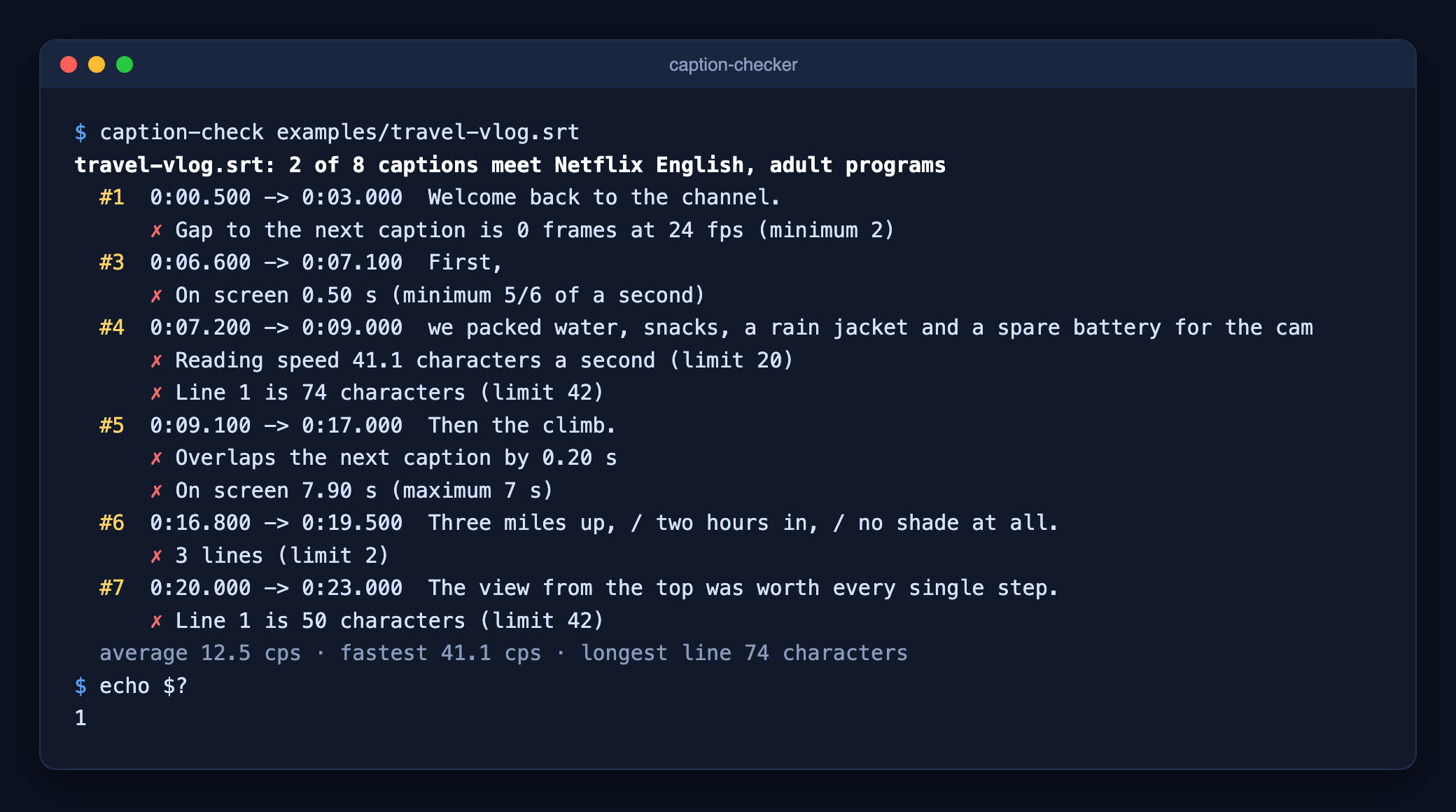
$ caption-check examples/travel-vlog.srt
travel-vlog.srt: 2 of 8 captions meet Netflix English, adult programs
  #1  0:00.500 -> 0:03.000  Welcome back to the channel.
      ✗ Gap to the next caption is 0 frames at 24 fps (minimum 2)
  #3  0:06.600 -> 0:07.100  First,
      ✗ On screen 0.50 s (minimum 5/6 of a second)
  #4  0:07.200 -> 0:09.000  we packed water, snacks, a rain jacket and a spare battery for the cam
      ✗ Reading speed 41.1 characters a second (limit 20)
      ✗ Line 1 is 74 characters (limit 42)
...Each limit was read on the standard’s own page on 2026-10-15.
| Netflix (English) | BBC | DCMP Captioning Key | |
|---|---|---|---|
| Reading speed | Up to 20 characters a second (adult), 17 (children’s) | 160–180 words a minute | Up to 130 / 140 / 160 words a minute (lower / middle / upper level) |
| Characters a line | 42 | 37 on broadcast (Teletext) | No character count |
| Lines a caption | 2 | 2; 3 for vertical 9:16 video | No more than 2 preferred |
| Shortest time on screen | 5/6 of a second | About 0.3 s a word (advice) | 40 frames (1 second and 10 frames) |
| Longest time on screen | 7 seconds | No number | 6 seconds |
| Gap between captions | 2 frames minimum; gaps under 0.5 s closed to 2 frames | If you leave a gap, at least 1 second (advice) | No rule |
Sources: Netflix English (USA) Timed Text Style Guide (opens in a new tab) · Netflix General Requirements (opens in a new tab) · Netflix Subtitle Timing Guidelines (opens in a new tab) · BBC Subtitle Guidelines (opens in a new tab) · DCMP Captioning Key: Text (opens in a new tab) · DCMP Captioning Key: Presentation Rate (opens in a new tab)
How it counts. Characters include letters, spaces and punctuation, but not line breaks or formatting (<i> tags, {\an8} codes, WebVTT voice spans). Reading speed is characters ÷ (out-time − in-time). Words are runs of characters that hold a letter or a digit, so speaker labels and sound tags count, as DCMP asks. Gaps run from one caption’s out-time to the next caption’s in-time, in frames at the frame rate you give. Anything a standard words as a recommendation is reported as advice, not as a failure.
npx github:markksantos/caption-checker#v1.3.3 captions.srt
# or: git clone --depth 1 --branch v1.3.3 https://github.com/markksantos/caption-checker && node caption-checker/bin/caption-check.js captions.srt
# (#v1.3.3 and --branch v1.3.3 pin a tagged release; without them you get whatever is on main)

caption-check <file.srt|file.vtt> [more files] [options]
  -s, --standard <id>   netflix | netflix-kids | bbc | dcmp-upper | dcmp-middle | dcmp-lower  (default: netflix)
  -f, --fps <rate>      frame rate for frame-gap checks (default: 24)
      --vertical        9:16 video (the BBC allows three lines)
      --json            JSON output
      --advice          also print advice-only notes
      --fix <out>       write a fixed copy to <out> (one input file)
      --mcp             run as an MCP server on stdio

caption-check <file> --to vtt|srt [--speakers] [--crlf] [--out <file>]                     convert
caption-check <file> --shift <time> [--from <n>] | --start-at <n=time> | --rate <from:to> | --sync <n=time,n=time>
              [--to vtt|srt] [--out <file>]                                                retime
It exits with 1 when any caption breaks a limit, so it works as a CI check before captions ship.
--fix writes a copy with every fix that doesn’t need a person: it never changes a word or an in-time.
$ caption-check examples/travel-vlog.srt --fix fixed.srt
travel-vlog.srt: 8 changes in 7 captions, written to fixed.srt
  #1  Out-time 0:03.000 -> 0:02.916 (to leave 2 frames before the next caption)
  #4  Rewrapped to 2 lines (38 + 35 characters)
  #5  Out-time 0:17.000 -> 0:16.100 (off an overlap, to the 7 s maximum)
  ...
  Left for a person (2):
  #3  Still on screen only 0.52 s (minimum 5/6 of a second) with no free time after it: merge it with a neighbor or move the next caption
  #4  Still reads at 40.2 characters a second (limit 20) with no free time after it: split it, condense it or move the next caption
fixed.srt: 6 of 8 captions meet Netflix English, adult programs (before: 2 of 8)Run against 300 caption files with all six standards, it never changed a word, an in-time or the number of captions, and never left more captions failing than it started with.
--to converts SubRip to WebVTT or back; the retiming flags fix captions that are out of sync with the video. Without --out, the file goes to stdout and the summary to stderr.
$ caption-check examples/travel-vlog.srt --to vtt --out travel-vlog.vtt
travel-vlog.srt: 8 captions converted from SubRip (.srt) to WebVTT (.vtt).
Written to travel-vlog.vtt
$ caption-check episode.srt --shift -2.5 --from 120 --out episode.synced.srt     # late by 2.5 s from caption 120 on
$ caption-check film.srt --rate 23.976:25 --out film.25fps.srt                     # timed for 23.976 fps, video is 25 fps
$ caption-check film.srt --sync 1=0:04.200,640=41:12.5 --out film.synced.srt # pin two captions, stretch the rest{\an8}-style position codes become WebVTT line/align settings and back; & and < are escaped for WebVTT and unescaped for SubRip; <v Name> voice tags become “Name: “ with --speakers. Whatever the other format can’t hold (font colours, NOTE blocks, WebVTT position or size) is listed, not silently dropped.It uses the same reader and writer as the online SRT to VTT converter (opens in a new tab) and subtitle time shifter (opens in a new tab) (subtitles.js is that code, unchanged). Run on 300 caption files (34,836 captions), SRT to WebVTT and back kept every caption’s timing, and a shift there and back restored every time.
const { parse, check, fix } = require('caption-checker');
const result = check(parse(fs.readFileSync('captions.vtt', 'utf8')), 'bbc', { vertical: true });
console.log(result.flagged, 'of', result.cues.length, 'captions break a limit');
for (const cue of result.cues) for (const issue of cue.issues) console.log(cue.n, issue.severity, issue.message);

const fixed = fix(fs.readFileSync('captions.srt', 'utf8'), 'netflix', { fps: 25 });
fs.writeFileSync('captions.fixed.srt', fixed.text);   // also: fixed.changes, fixed.unresolved, fixed.before, fixed.after

const { convert, retime } = require('caption-checker/convert.js');
const vtt = convert(srtText, 'vtt');                                   // { text, from, to, captions, notes }
const synced = retime(srtText, { rate: { from: 23.976, to: 25 } });    // or { offset: '-2.5', from: 120 }, { startAt: { caption, time } }, { sync: [a, b] }
check() accepts a standard id or your own standard object with the same fields as STANDARDS in index.js.
The same checks run as an MCP server, so Claude, Cursor, VS Code and other MCP clients can check a caption file mid-task. Five tools: check_captions (a file path or pasted SRT/VTT text, a standard, fps, vertical), fix_captions (the same arguments; returns the fixed file and what changed), convert_captions (SRT to WebVTT or back), retime_captions (offset, start at, frame-rate change or two-point sync) and list_standards (each limit and the page it comes from). It runs locally: no key, no network.
# Claude Code plugin (MCP server + a caption QA skill)
/plugin marketplace add markksantos/caption-checker
/plugin install caption-checker@caption-checker

# or the server on its own
claude mcp add caption-checker -- npx -y github:markksantos/caption-checker#v1.3.3 --mcp
Other clients:
{ "mcpServers": { "caption-checker": { "command": "npx", "args": ["-y", "github:markksantos/caption-checker#v1.3.3", "--mcp"] } } }The skill in skills/caption-checker/SKILL.md tells an agent which standard to pick, how to report results and how to fix a caption without changing its words. skills/caption-fixer/SKILL.md covers fixing a file: what fix_captions changes, and what to do with the captions it leaves for a person. skills/caption-converter/SKILL.md covers converting between SRT and WebVTT and working out which kind of timing fix an out-of-sync file needs.
study/ (opens in a new tab) holds the code and data behind the caption reading speed study (opens in a new tab): 339,521 captions in 387 NASA videos and MIT OpenCourseWare lectures, measured with this library.
study-auto-captions/ (opens in a new tab) holds the YouTube auto-caption accuracy study (opens in a new tab): automatic vs human captions on 299 videos, plus caption coverage of the most-subscribed channels.
study-dubbing/ (opens in a new tab) holds the YouTube dubbing study (opens in a new tab): every audio track on 485 videos from the 97 most-subscribed channels, split into the channels’ own dubs and YouTube’s automatic ones.
study-video-length/ (opens in a new tab) holds the YouTube video length study (opens in a new tab): durations of 2,859 latest videos and the Shorts share of 1,484 recent uploads on the most-subscribed channels.
See CHANGELOG.md (opens in a new tab) and releases (opens in a new tab).
npm testMIT © Mark Studios (opens in a new tab), a video editing (opens in a new tab) and production studio.
main, last pushed 1 November 2026.SKILL.md, not by matching a directory convention. One layout observed: skills/*/SKILL.md.h1 and no skipped levels:.claude-plugin/marketplace.json by Mark Studios, declaring 1 plugin. It is read for editorial metadata only — never as the skill index, which is always the repository tree./markksantos/caption-checker.md, and each skill at its own .md URL.